How to Search Criminal Dockets
Pull the court name, case number, and location off any Tallahatchie County notice or old order. Do that before you call anyone. Felonies usually live with the Tallahatchie County Circuit Clerk through the Seventeenth Circuit MEC route. Smaller criminal matters may belong to a Justice Court clerk or a municipal clerk instead. Remember that the county splits into Charleston and Sumner judicial districts. The district matters as much as the county name. Keep that in mind when a clerk hunts for a file.
No free statewide Mississippi case search pulls together every Tallahatchie County trial court. For a participating Circuit Court case, the practical remote route is Mississippi Electronic Courts. Public viewing runs through PAMEC. If a record is not online, call or visit the Circuit Clerk. Daphane B. Neal holds that office. The Charleston number is 662-647-8758, and the Sumner number is 662-375-8515. Ask first before mailing a written request. The clerk offers no online request form.
- Identify the court, Tallahatchie district, and case number if known.
- Use the Seventeenth Circuit MEC route for a participating Circuit matter.
- Confirm the court, case type, filing date, and status before relying on a match.
- Read the docket in date order, separating a setting from an order.
- Ask the proper clerk for a docket sheet, document copy, or certification.
Tallahatchie Criminal MEC Access
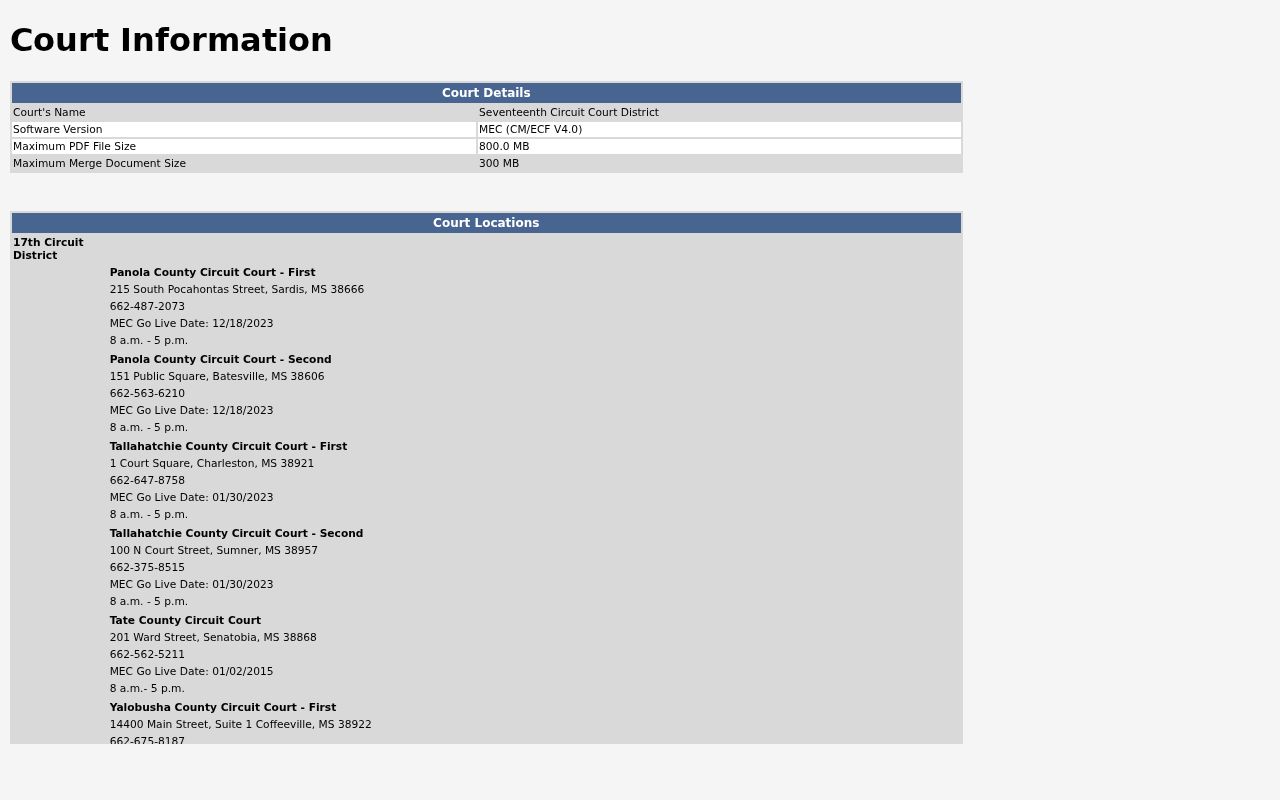
The public Seventeenth Circuit MEC entry names the Tallahatchie County court system. Casual visitors get no open criminal case-search form. Its Court Information page is still handy for one thing. It confirms that Tallahatchie County runs separate Charleston and Sumner Circuit locations. That matters. It keeps you from treating the two county seats as a single records counter.
PAMEC is how the public reaches participating Tallahatchie County courts remotely. For a non-attorney account, the published terms describe read-only viewing. Expect a $10 registration fee each year, plus $0.20 per page. Even a no-match search can trigger a one-page charge. Remote access covers only participating courts, and restricted Tallahatchie County records stay off limits. Check the current terms and fees before you sign up.
The official Circuit Court Information page gives one key date. Tallahatchie County's Circuit MEC go-live date was January 30, 2023. Anything older, whether paper, legacy, or restricted, may still need the clerk or an archive. The online route is a genuine convenience. It is no promise that every historical criminal file has been scanned.
The official MEC Court Information source is shown below.
What a Criminal Docket Shows
A Tallahatchie County docket sheet reads like a timeline. Expect the basics. The court, district, case type, filing date, and judge head the list. Status and a running list of filings and settings follow. The sheet is an index, not a copy of every document behind each entry. A motion marked as filed was not necessarily granted. A court date is just a setting. A setting is not proof the event ever took place.
| Case number | Use the Tallahatchie County clerk’s recorded Circuit number; no Tallahatchie County criminal format was publicly confirmed. |
|---|---|
| Court and district | Verify Tallahatchie County Circuit Court and whether the Tallahatchie County file is tied to Charleston or Sumner. |
| Charging event | A Tallahatchie County indictment or charging instrument is a procedural entry, not an outcome. |
| Setting | Tallahatchie County arraignment, pretrial, plea, trial, or sentencing can appear as a dated docket event. |
| Status and order | Read the actual Tallahatchie County order when a result or disposition matters. |
A label like Trial Pending is a system flag inside the Tallahatchie County record. Read it together with the docket line and the underlying order rather than treating it as the result. The sequence of entries gives the flag its real context.
Tallahatchie Criminal Status Flags
Seventeenth Circuit MEC information for Tallahatchie County lists many status flags. The list includes APPEAL, BOUND OVER, Plea Pending, Trial Pending, Nolle Pros Pending, CLOSED, SEALED, and EXPUNGED. Each label points you to what to check next. None of them is a complete legal conclusion on its own.
A "nolle pros" entry, for instance, is not an acquittal. A "closed" label does not prove that. Every cost, probation term, appeal, or expungement issue may still be open. A charge, accusation, warrant, or plea setting is not a conviction either. Turn to the docket and the controlling order. Together they supply the procedural meaning.
- Bound over
- A Tallahatchie County lower-court matter transferred onward, often with a related Circuit case number.
- Legacy case
- An older Tallahatchie County record migrated or labeled by the electronic system; entries can be less complete.
- Sealed
- A Tallahatchie County access restriction controlled by law, rule, or court order.
Stages on a Criminal Docket
A typical Tallahatchie County Circuit case starts with a charging instrument or indictment. Arraignment follows. Then come counsel activity, bond or release entries, discovery, and motions. A plea or trial setting comes next, followed by a verdict, plea, judgment, or sentence. After that, expect post-trial motions or a notice of appeal. Mandate, restitution, probation, or cost activity may follow. The order varies by case. Entries can also post after the event they record.
Docket flow: Filing › Arraignment › Pretrial › Plea or Trial › Disposition › Sentencing
Check for a later Tallahatchie County order before assuming an earlier setting was the final step. If an appeal appears, the Mississippi Supreme Court or Court of Appeals keeps its own appellate docket. The Tallahatchie County Circuit Clerk still holds the trial record.
Tallahatchie Criminal Court Split
Tallahatchie County sits in the Seventeenth Circuit Court District. Panola, Tate, and Yalobusha Counties share it. Its Circuit Court actually works from two seats. First Judicial District terms are held in Charleston. Second Judicial District terms convene in Sumner. That split matters for anyone pulling a Tallahatchie County criminal docket. A records request naming only the county can go astray. It might land at the wrong building. It might also come back missing local case context.
Felony prosecutions in Tallahatchie County run through Circuit Court. Justice Court and Municipal Court keep their own dockets for limited criminal and traffic matters. When a lower-court appeal or a bindover reaches Circuit, watch the file. It may carry a fresh or related case number. So ask the clerk to tie the originating court to the Circuit record. Do not assume a city or Justice Court outcome will surface in MEC on its own.
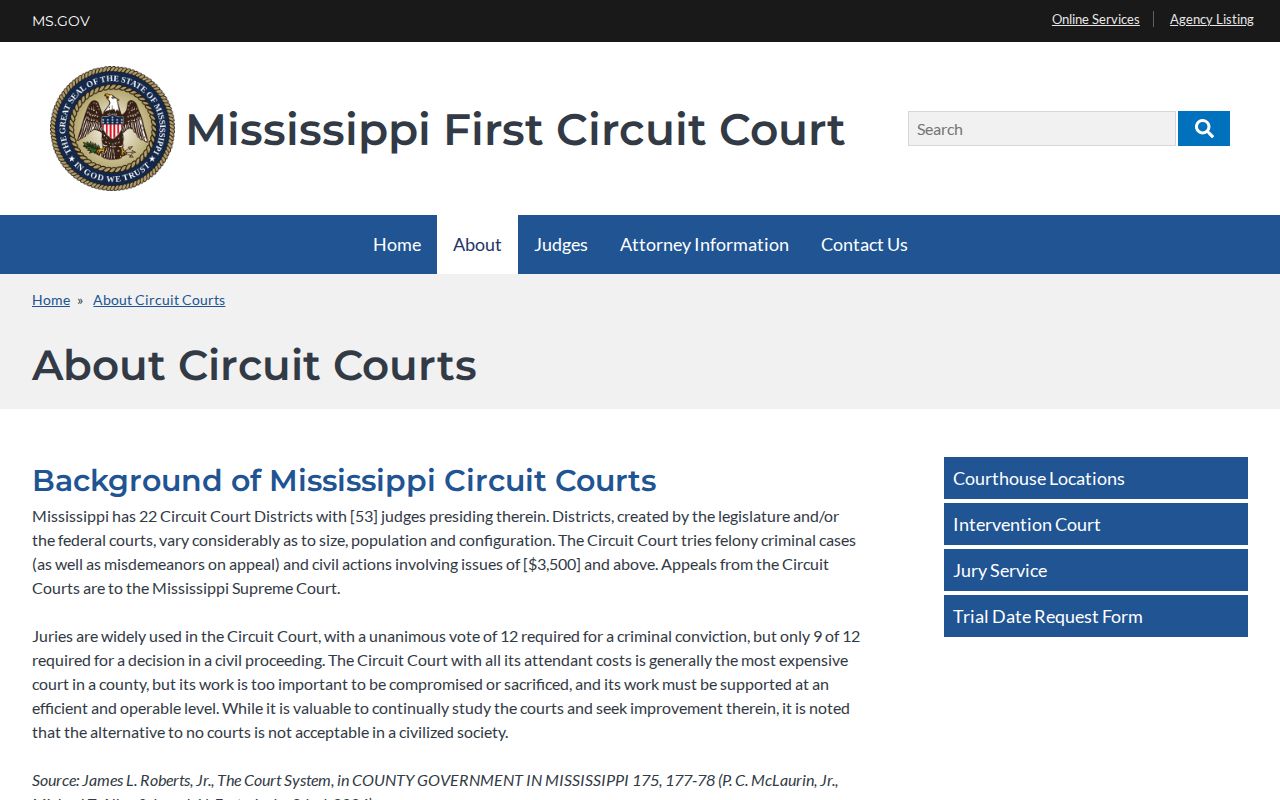
The Mississippi judiciary’s Circuit Court overview explains the court’s criminal, general civil, and appellate role statewide. It also answers a key question. The Tallahatchie Circuit Clerk, not the Chancery Clerk, is the first stop for a felony docket.
The official Circuit Court jurisdiction explanation appears below.
Which Court Holds Criminal Dockets
Where do you start? For a Tallahatchie County felony case, go to the Circuit Clerk or use the MEC/PAMEC route. For limited criminal or traffic matters, start with the Justice Court clerk for the citing district or the municipal clerk for the named city. Justice Court District 1 sits in Charleston; District 2 sits in Sumner. Municipal dockets for Charleston, Glendora, Sumner, Tutwiler, and Webb stay with each city.
Chancery Court handles a separate stream entirely: equity, domestic, probate, estates, guardianship, land, and related matters. It is not the keeper of a Tallahatchie County Circuit criminal docket. The state directory lists no County Court for Tallahatchie County, so no Tallahatchie County Court criminal file exists to search for.
Tallahatchie Criminal Record History
January 2023 changed how Tallahatchie Circuit Court records work. That is when MEC went live for the court. It was not a hard line in time. Older files did not vanish, and newer files did not all become public online. Sealed or restricted documents still follow access rules no matter their age. Some entries reflect a different source history.
For deep historical digging, look to the state archives. The Mississippi Department of Archives and History lists Tallahatchie Circuit Court Cases in boxes 10020 and 10042. The catalog notes that these older cases have no index. That lead is an archive pointer, not a modern case search. A historical file may sit beyond an electronic docket search. Staff help, box-level review, or a clerk or archives request may be the only way to reach it.
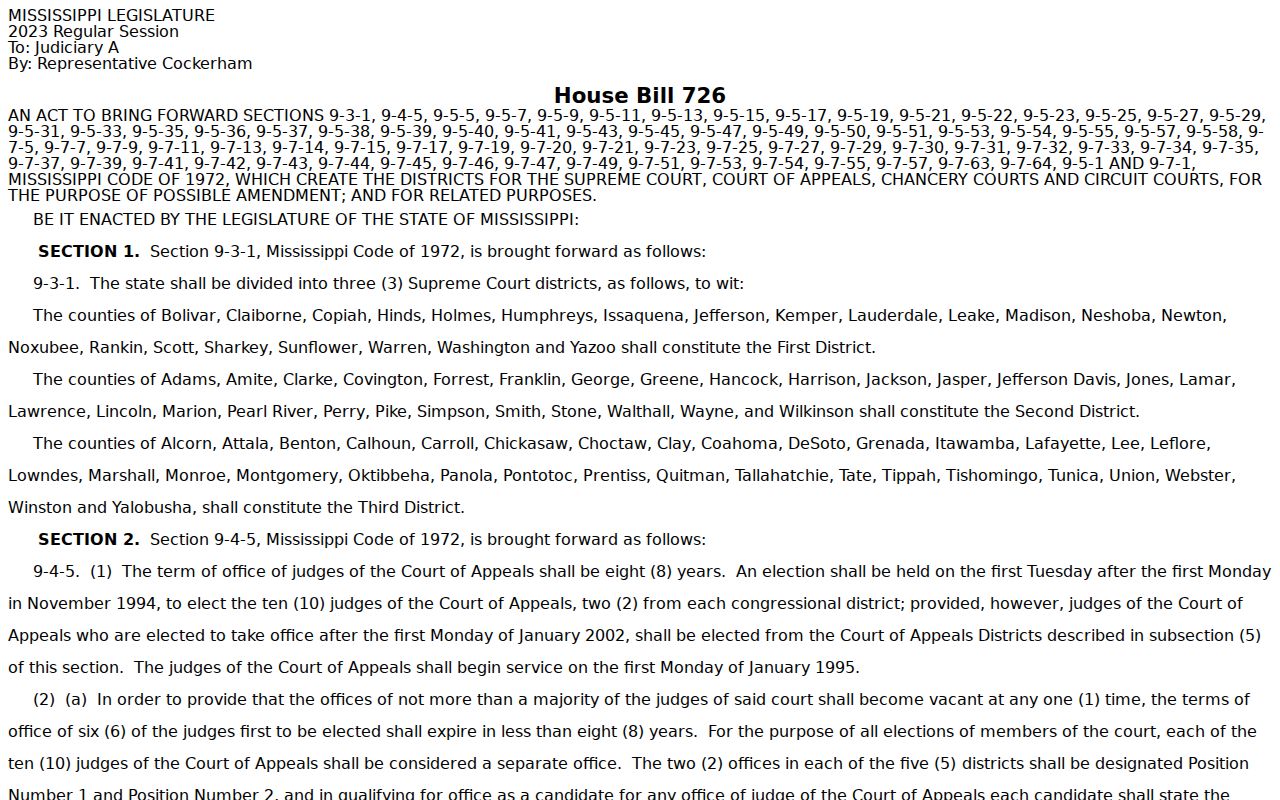
The official legislative district source is shown below.
Public Access and Sealed Criminal Dockets
Mississippi's Public Records Act gives the public a broad right. You may inspect and copy public records, subject to exemptions. Court records answer to additional rules, statutes, and orders. Access rights do not unlock everything. They do not open a sealed filing, an expunged matter, juvenile material, protected financial or medical information, grand-jury material, or a confidential exhibit.
Ask the clerk about docket-only inspection, a redacted copy, or a specific order. Never use another person's account, automate PAMEC searching, or work around a restriction. If a record is denied, request the rule, statute, or order behind that decision. Then ask whether a lawful redacted route exists.
Access limits: The Mississippi Public Records Act is a starting point for public-record access, but Rule 5.1 and court orders can require redaction or limit disclosure in court filings.
Tallahatchie Criminal Clerk Requests
Give the clerk something to work with. List the court, district, case number, date range, record type, and the format you want. No case number? Offer an approximate filing year and the least identifying detail needed to find a public case. For a broad search, request inspection first. Then single out a particular docket or document for copying.
Tallahatchie County posts no criminal copy schedule online. Statutory baselines apply until the Circuit Clerk confirms otherwise. That means $1 for a complete certified filed document. Clerk-made copies run $1 per page. PAMEC access charges sit apart from copy or certification fees. Ask about payment methods, postage, and turnaround. Also ask about archive retrieval, and whether plain or certified copies are available.
The official Mississippi Supreme Court agency source is shown below.